01 Why I prioritize quantity, and the minimum standards I maintain
Even with photographs of ordinary gardens, parks, mountains, or hobbies, I feel the need to add assets with different uses. Rather than spending a long time on just one item, I want to finish assets that are sufficiently usable and give buyers more scenes and compositions to choose from.
I exclude obvious missed focus, severe camera shake, unusable correction artifacts, and logos that are difficult to remove. I do not skip rights relating to people and locations, necessary information, or platform conditions. Prioritizing quantity is different from skipping minimum quality standards and rights checks.
Past work may sell while I am not working. That does not guarantee income will continue forever without doing anything. I do not connect asset count and earnings with a fixed formula, or assume quantity alone is the sole rule for success with every subject.
02 Add different scenes and compositions without spending too long on one image
My retouching policy is to finish lightly, focusing on exposure, color, and contrast. I arrange light, backgrounds, and logos during the shoot to reduce corrections later. Once an image is sufficiently usable, I move on rather than polishing that same image without limit.
I do not simply want to increase the number of nearly identical shots. I create assets with different uses through orientation, close or wide framing, space, action, and scene. Platforms also have conditions for submitting similar content, so I do not assume lining up many tiny variations is the answer.
Keeping assets with different uses from one shoot makes the most of travel and preparation. On the other hand, if too many similar photographs prolong selection, I plan the necessary compositions and actions before shooting. I watch how much work reaches completion while gradually improving quality and themes.
03 Count finishing and submission time as well as cash expenses
Not paying a location fee or a cash fee to a model does not make production cost zero. Expenses include travel, parking, props, necessary meals, equipment wear, permits, and outsourcing. Even if friends or family help without payment, I still need to explain uses, confirm consent, link assets to documents, keep records, and respond to questions.
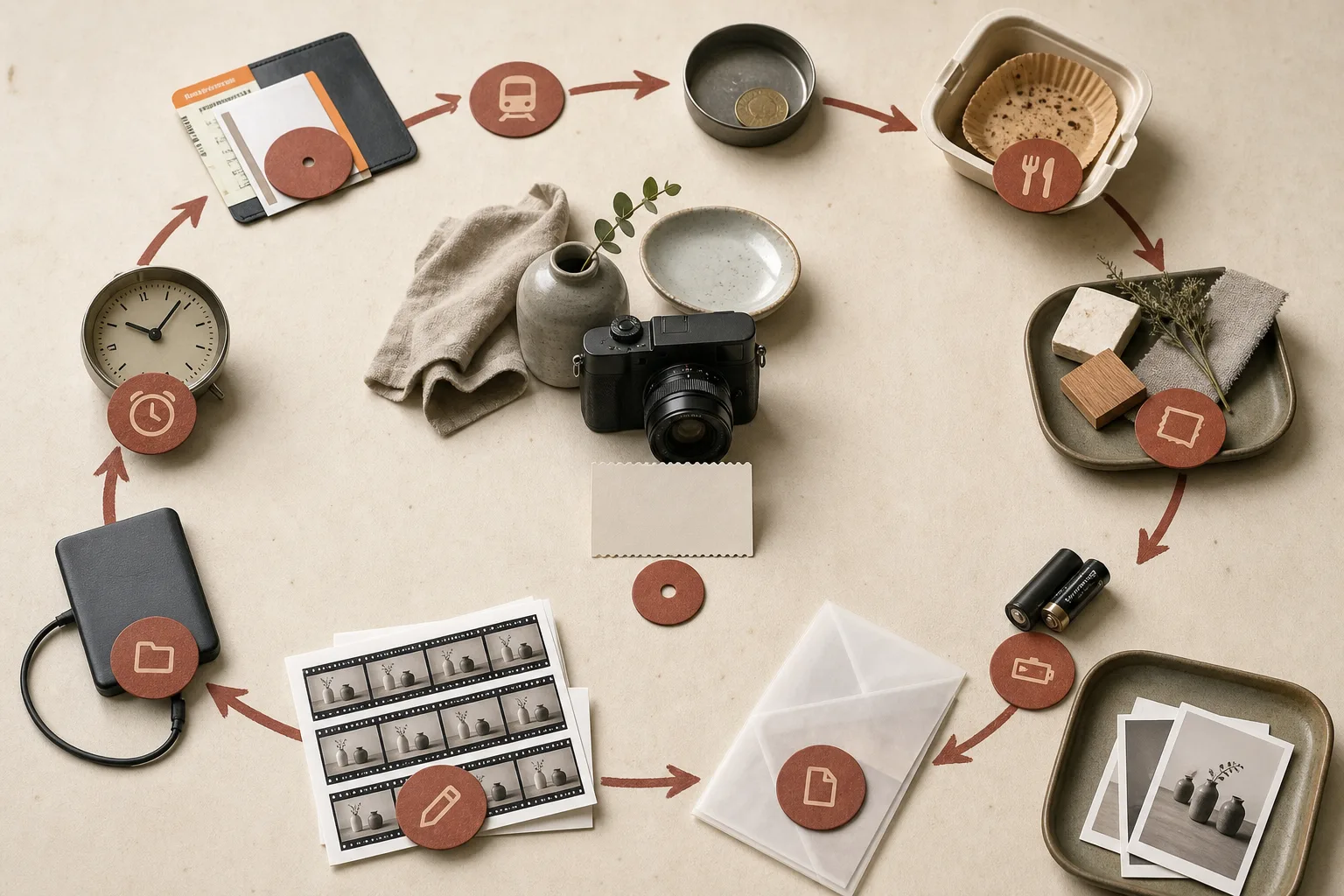
Planning, communication, travel, preparation, shooting, packing up, selection, editing, rights checks, information entry, submission, corrections, and backup all take time. I do not measure every asset in detail. As a tool when the workload is unclear, one approach is to start by taking notes under four headings: planning, shooting, finishing, and submission/management.
Travel and preparing the location are shared across the same shoot, while detailed corrections and additional checks may apply to particular assets. If dividing time or cost by the number of assets, decide whether the denominator is shots taken, finished assets, or accepted assets, and state it alongside the figure. Including large numbers of intermediate shots in the denominator can make production look cheaper and faster than it was.
When considering whether expenses can be recovered, I do not treat future royalties as one certain amount. It is possible to compare costs against several royalty scenarios using similar past assets as a reference, but that does not guarantee sales counts or a date for recovering the cost. I look separately at cash expenses alone and at costs including my own time.
Time records are not intended to stop me shooting or simply to turn speed into a competition. They help identify what could be improved to finish more assets. A rare location or a shoot serving several uses may be worthwhile even if it takes longer. I avoid shortening the work by cutting quality or rights checks.
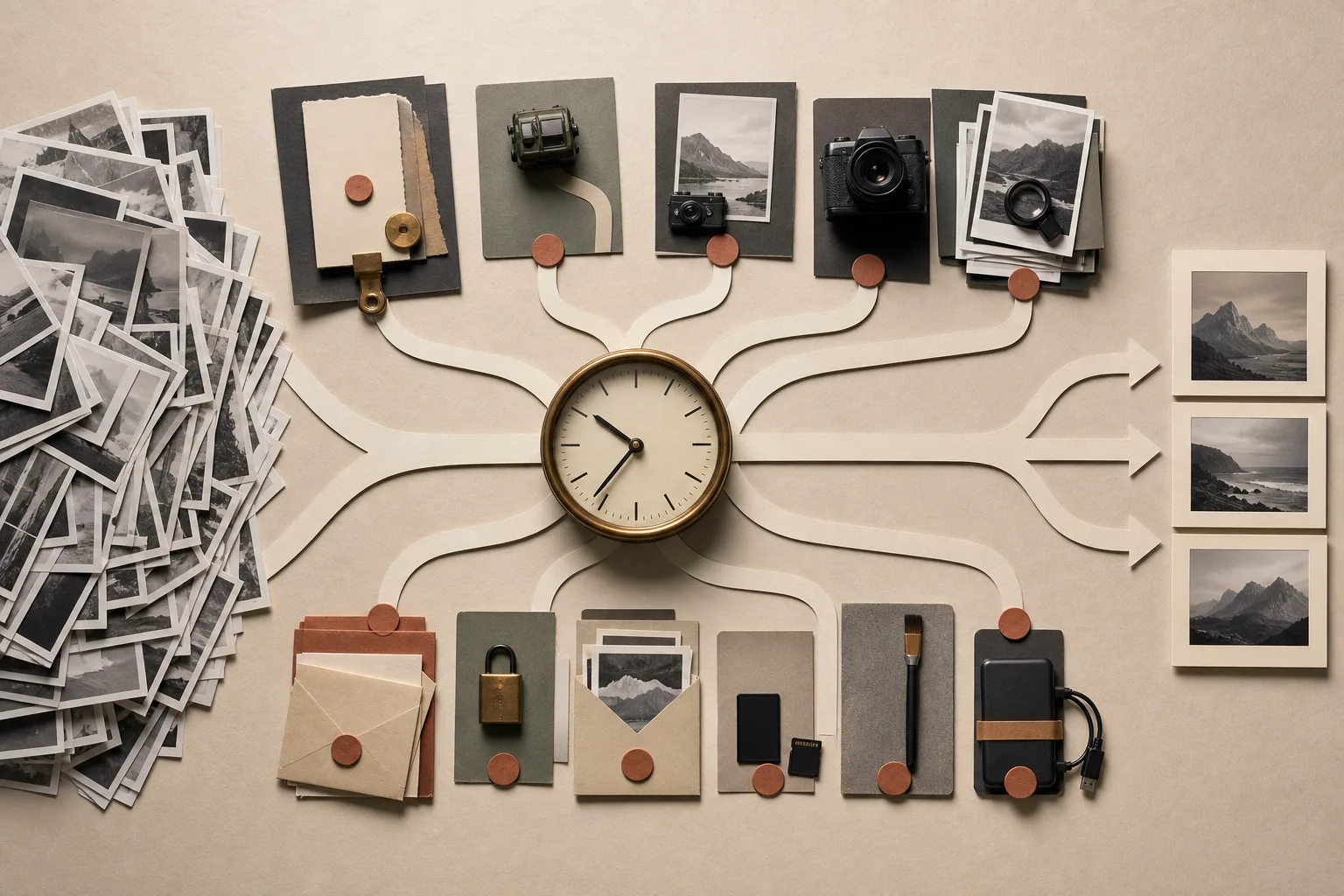
Divide production cost by an assumed royalty per sale to compare the number of sales needed to recover the cost. This does not predict that those sales will occur. To reduce time spent, improve one thing at a time, such as reusable messages or consistent pre-shoot explanations.
04 Keep submitting elsewhere while focusing on Adobe and iStock
My basic policy is to focus on Adobe and iStock while submitting to other candidate sites from the beginning. Rather than switching platforms in response to small monthly fluctuations, I continue while considering the assets I can create and the work required.
On October 9, 2026, my Adobe Stock account was suspended, and I am appealing. I do not present this basic policy as meaning I can currently submit to Adobe. My response during the suspension and its progress are covered in a separate article, distinguished from the shooting, finishing, local storage, and other permitted stages I can work on now.
Whether assets can be submitted to multiple sites depends on the type of content and the contract. iStock has exclusive and non-exclusive conditions for different content types, so I do not treat the same asset as suitable for submission everywhere without checking my contract. When royalties, permitted uses, AI terms, payment conditions, or similar matters change, I check the official guidance and contract.
When comparing platforms, I consider not only royalties but also the work of preparation, keywords, consent, platform-specific corrections, transfer, inquiries, and receiving payments. Ease of working and actual results are separate records. A small number of submissions can test a procedure, but there are limits to what it can establish about demand.
When needed, I can decide to increase, maintain, or pause new submissions. Pausing new submissions is different from deleting already accepted assets. Setting conditions for reviewing the policy—such as portfolio growth or changes to submission methods or terms—helps me avoid changing course simply because nothing sold for a week.
When choosing a destination, check tax information requirements, asset-specific additional agreements and withdrawal procedures, and record the date checked. Use the current agreement and the terms that actually apply to you.
05 Highest payment, most sales, and cumulative revenue are different figures
“Best-selling asset” can mean the item with the most sales, the highest cumulative royalties, the highest royalty from a single sale, or strong recent sales. I do not equate one high-value sale with evidence of sustained demand.
For comparisons, I use equal periods where records are available, such as the first 90 or 365 days after publication. Sales or royalties per month available for sale can also be useful. This cannot fully remove differences in timing, market, or platform, however. It is a way to avoid comparing only the cumulative totals of a newly published asset and one that has been sold for years.
I also distinguish long periods without sales, short bursts of revenue, and sales across seasons or years. If calculating a proportion of accepted assets that have sold, I include how many out of how many, and the period covered. Submission count, acceptance count, published asset count, and number of sales are different figures.
When considering why an asset sold, I look for features I can test again: subject, theme, location, season, orientation, space, action, or clip length. This is a hypothesis, not confirmation that equipment or atmosphere was the buyer's reason. Looking at results across several assets with similar uses provides more evidence than one sale alone.
I include Connect in revenue totals, but do not pay particular attention to it when deciding what to shoot. As with an individual high-value sale, I separate accounting figures from decisions about the next shoot.
First and last sale dates and average royalty per sale can also help comparisons. Distinguish repeated licensing across dates, buyers and sites to examine continuity that a single high-value sale cannot establish.
06 Distinguish repeatable shoots from one-off shoots
I use high-value sales as a reference, but do not insist on recreating the same shoot. A special trip or one-off event may have value in its own moment, but it differs from a shoot that can be repeated every month. I consider the burden of doing it again, including travel, time, permissions, consent, editing, and storage.
Rather than copying the appearance of an asset that sold, another approach is to create different assets for similar uses. I change one element—subject, location, season, angle, orientation, movement, or space—and test a small series while preserving its use. I do not concentrate a large budget on the same scene without knowing the buyer's reason.
Nearby, repeatable shoots make it easier to test the next improvement. Rather than dismissing one-off shoots, I distinguish their value from shoots that support everyday production. If a pattern continues across several assets, that becomes a reason to consider spending more time on it.
07 Keep fixed costs manageable so production can continue through low-sales months
I want to keep steadily doing the necessary shooting and submission preparation even in low-sales months. I try not to suddenly add equipment or contracts, or abandon all production, because of one high-value sale or one weak month.
Before increasing fixed costs, I check whether I can use my existing computer or secondhand equipment, and which stage stalls each week. I keep commitments within a range I can sustain, including storage, software, connectivity, repairs, and upgrades. Even to increase quantity, I do not omit rights or image quality checks.
To start keeping records, I can note assets finished this month, assets that reached publication, expenses, stages that took significant effort, and results over a defined comparison period. Maintaining a small set of information useful for the next production is more helpful than trying to collect every detailed measurement.