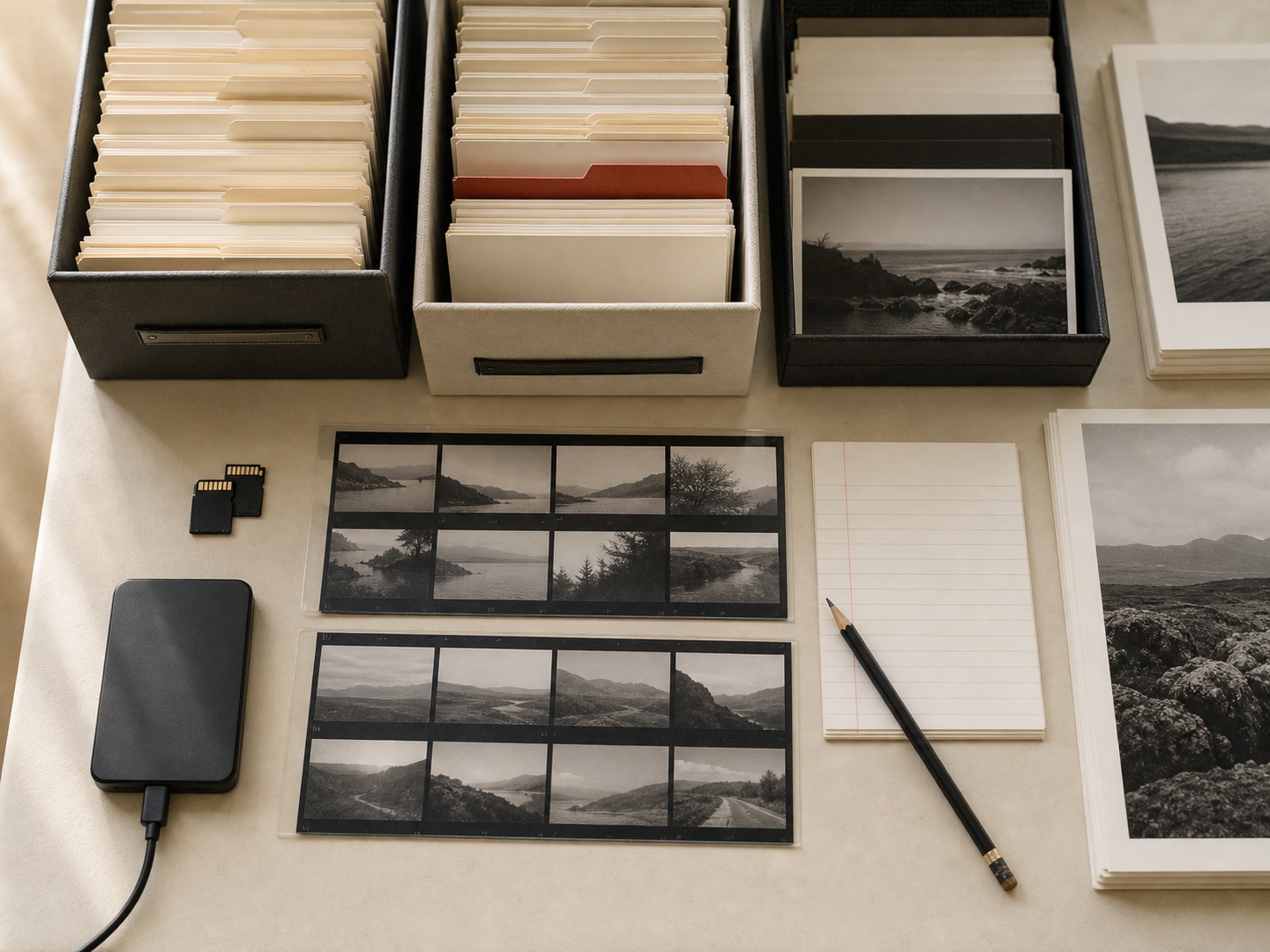
The camera creates possibilities. The archive decides whether those possibilities remain usable. When originals, exports, metadata, releases, and submission history drift apart, every future request becomes an expensive investigation.
Give every capture a durable identity.
Folder names should describe a real grouping such as date, project, place, or client—not a temporary mood like “good ones” or “new edit.” Preserve the original filename somewhere in the record even when a working copy receives a clearer name.
A durable identity lets you connect the master, edit, export, metadata, release, and submission history without depending on where one file happens to live today.
Separate originals, working files, and deliveries.
The untouched capture is evidence. The working file records interpretation. The delivery is a disposable output made for a particular destination. Treating them as the same object makes re-editing dangerous and quality loss difficult to trace.
Keep originals read-only in practice, create versioned edits, and regenerate platform exports when requirements change.
An archive is proven by retrieval, not by capacity.
A copy is not a backup until it is verified.
Before formatting a card or deleting a source, confirm that the destination contains the expected files and that important copies can be opened. For high-value transfers, compare checksums so the verification tests content rather than filenames or file counts alone.
Keep copies across separate failure domains. Two folders on one drive do not protect against the loss of that drive, and a synchronized mistake can reach every synchronized location.
Track rights and status outside the pixels.
Searchable metadata should describe what the asset shows. An operational ledger should describe what happened to it: selected, edited, rights cleared, exported, submitted, accepted, rejected, licensed, or held.
Those states are not interchangeable. An uploaded file is not necessarily submitted; a submitted file is not necessarily accepted; an accepted file is not evidence of a license.
Test the archive with a real question.
Can you retrieve every usable horizontal video from a particular location and season? Can you identify which version was delivered, whether recognizable people are cleared, and where the original lives?
If the answer requires opening folders one by one, the archive is relying on memory. Write down the missing field, repair a small batch, and let the retrieval failure improve the system.
The minimum recoverable record
- Stable asset identity
- Original and current master locations
- Verified backup state
- Rights and release status
- Platform and delivery history