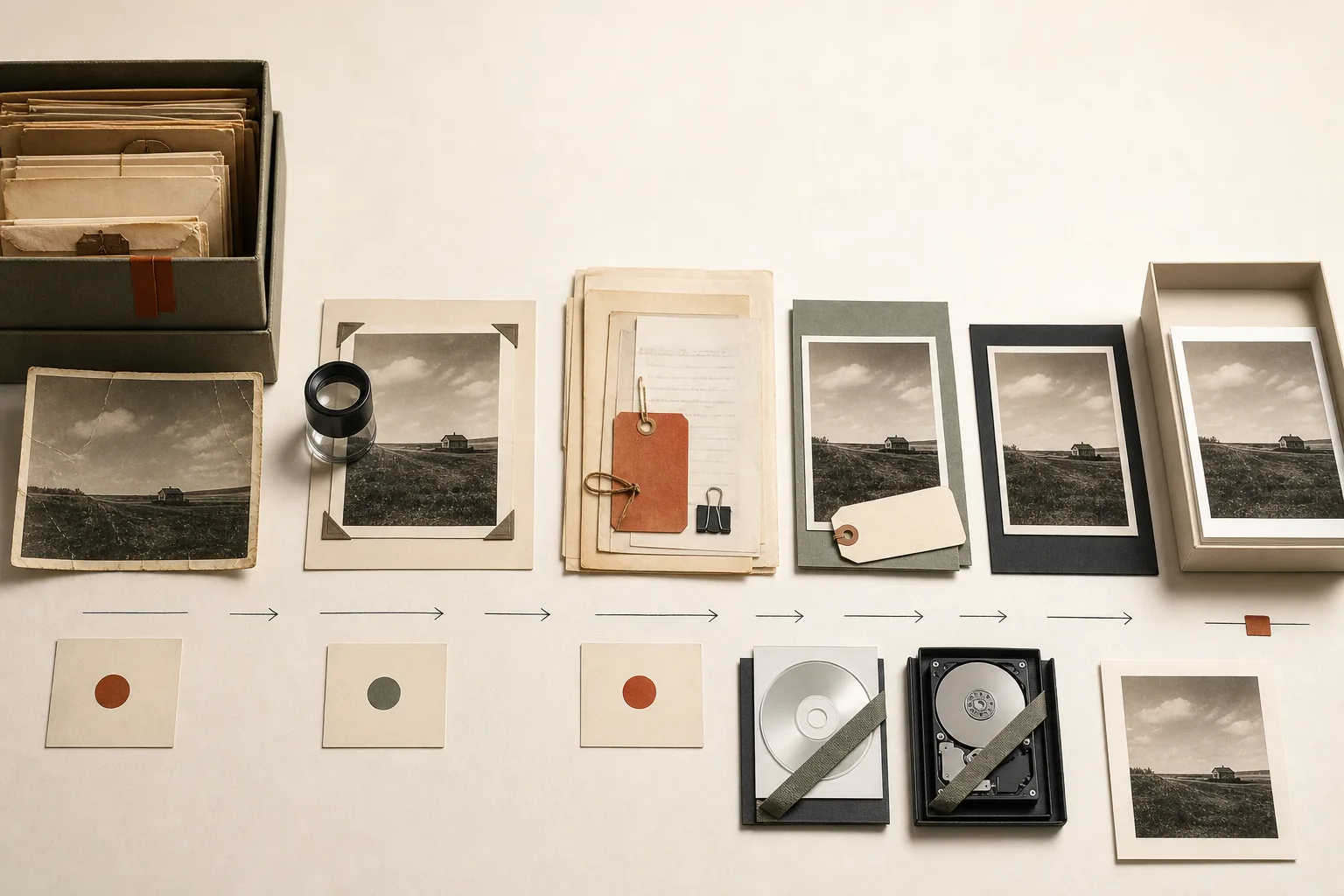
An archive can contain strong photographs that were never prepared for licensing. It can also contain small exports, uncertain permissions, outdated metadata, and subjects whose meaning has changed. Treat reuse as a new production decision, not as a shortcut around review.
Return to the file closest to the original capture.
A social-media download or an old delivery JPEG may be smaller, more compressed, or already sharpened. Locate the raw file or highest-quality master before deciding what the photograph can become.
Keep the old derivatives as history. Create a new working version and preserve the source so that the reuse process remains reversible.
Inspect quality with today’s finished use in mind.
Check focus, motion, noise, highlights, shadows, dust, edges, retouching artifacts, and usable dimensions at the intended output size. A file that looked acceptable on an older screen may reveal different limits now.
Do not enlarge or repair by habit. First decide whether the source carries enough real detail for the finished asset.
Do not extend old permission beyond what it actually covers.
Recheck recognizable people, private property, artwork, brands, documents, screens, and event restrictions. An old release or client agreement does not automatically authorize every new commercial use.
If the evidence is missing or the scope is unclear, keep the file on hold. Time does not turn uncertain permission into permission.
Read the subject in its historical context.
Products, interfaces, signs, protective equipment, workplace practices, and public guidance can date an image. That may make the photograph valuable as a specific historical or editorial record, or misleading as a current commercial scene.
Describe only what can be verified from the frame and reliable records. Do not silently update an old situation with present-day assumptions.
Give the reused asset a new production record.
Record the source location, capture date, review date, rights evidence, corrections, export settings, metadata version, submission state, and backup location. The new deliverable should be traceable without erasing the history of the original.
This step turns a rediscovered file into managed inventory. Without it, the archive remains a collection of possibilities rather than usable assets.
Fresh-check sequence
- Find the strongest source file
- Inspect present-day technical quality
- Verify the exact scope of permission
- Review historical context and description
- Create a traceable derivative and record