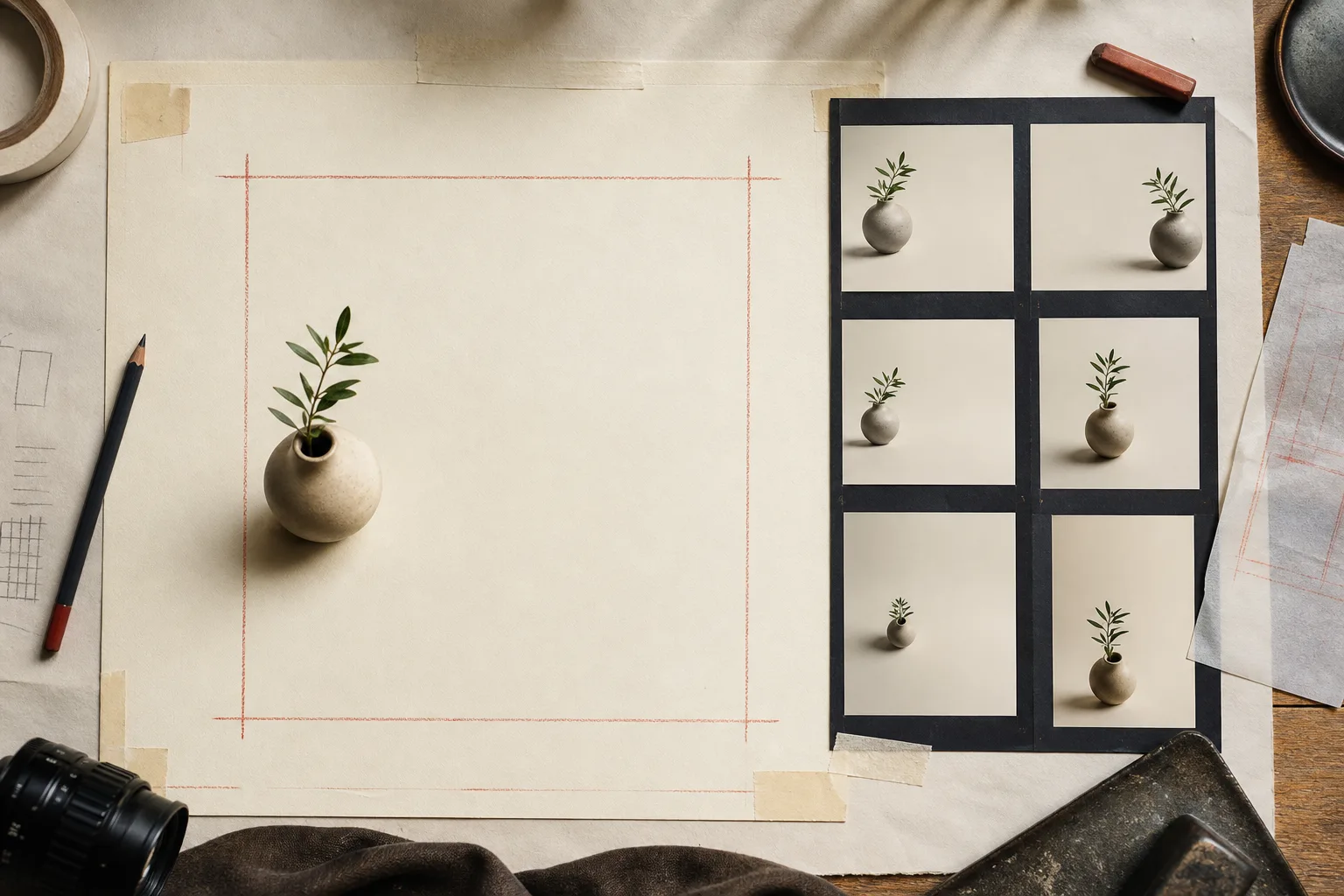
The instinct to fill the frame is powerful. It can also remove the very thing a designer needs: somewhere to place a headline, crop for another format, or adapt the image without cutting into the subject.
Treat empty space as working space.
Copy space is not dead space. It is room for a buyer to add language, a logo, navigation, or a call to action. The space must still feel intentional: calm enough to carry information, but connected to the subject through light, color, and direction.
Look for simple walls, open sky, quiet water, soft shadow, an uncluttered table, or a controlled area of shallow focus. Texture is often useful. Visual noise is not.
Make the frame easy to reverse.
A subject looking or moving into the frame usually creates usable space in front of them. When practical, capture a second version with the subject on the opposite side. A horizontal and a vertical variation can turn one setup into several genuinely different design options.
Compose the photograph. Preserve the options.
Shoot a little wider than your final instinct.
A tight frame may look stronger on the camera screen, but it leaves little recovery room. A slightly wider version protects limbs, shadows, architecture, and environmental context while giving the buyer space for square, portrait, landscape, and banner crops.
This is not a rule to make every subject small. Make the deliberate composition first, then record one insurance frame with more breathing room. Extra pixels are useful only when the subject remains clear.
Protect quality before you promise flexibility.
Cropping depends on a clean source file. Check critical focus, motion blur, highlight clipping, shadow noise, flare, chromatic aberration, and compression at a meaningful viewing size—not only as a thumbnail.
A higher-resolution camera can provide more editing latitude, but resolution does not rescue missed focus or poor light. Use the camera that lets you make a technically sound file consistently.
Keep the best source, not only the finished export.
RAW capture can preserve more adjustment latitude when the scene is difficult, while a carefully exposed JPEG may be entirely workable for straightforward conditions. The important business habit is to retain the strongest source file, export to the destination’s current requirements, and avoid repeated lossy saves.
Before uploading, inspect the exported file again. The edit is not finished until the deliverable—not just the master—survives review.
A five-frame field set
- The deliberate hero composition
- A wider insurance frame
- Copy space on the left
- Copy space on the right
- A vertical alternative