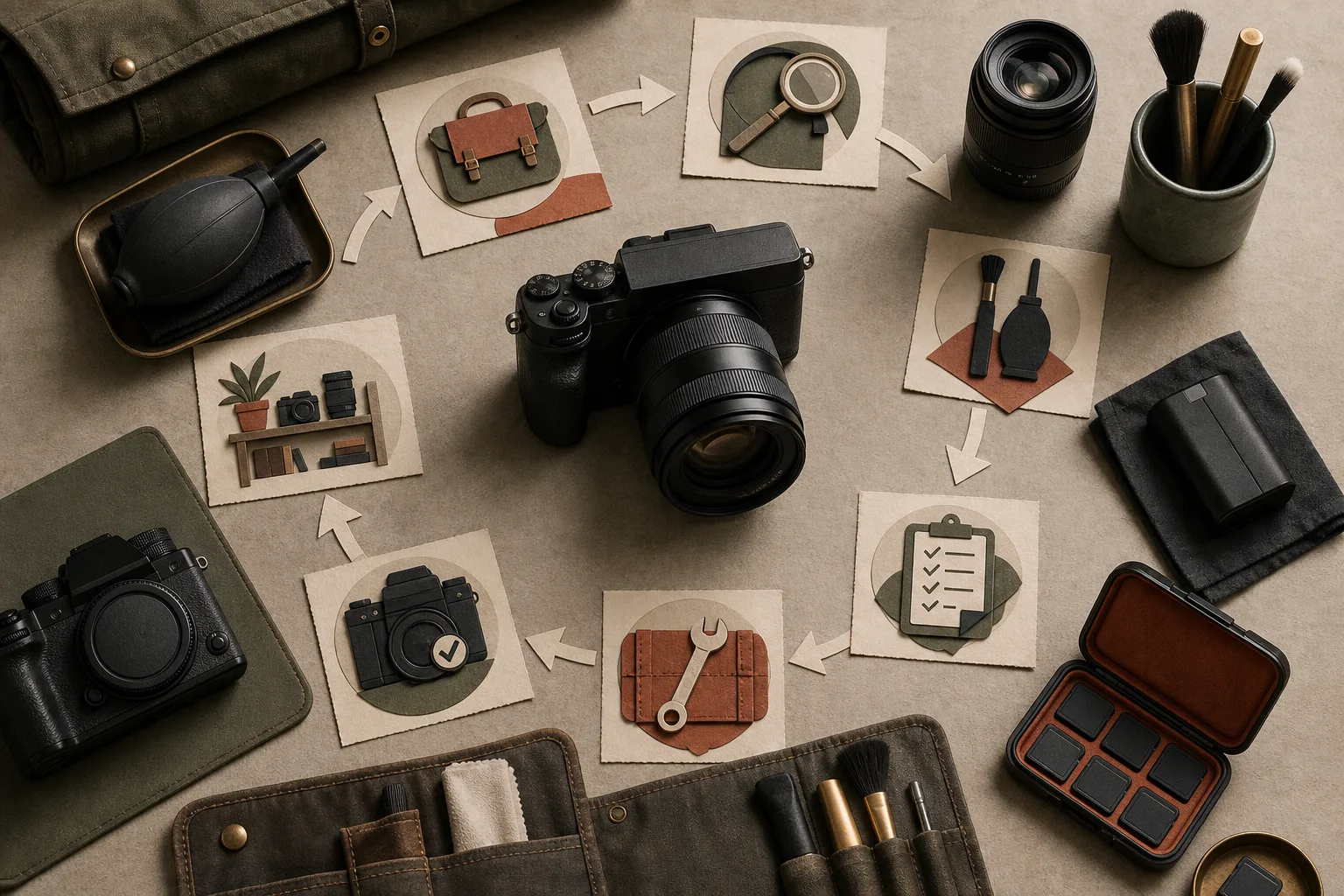
Camera care is easy to postpone because it rarely creates a photograph. But a working kit is production infrastructure. Maintenance protects continuity, while records turn a vague equipment problem into something another person can diagnose.
End the shoot before you put the camera away.
Brush or blow away loose grit before wiping a surface. Check the front and rear lens elements, caps, mount, contacts, card doors, ports, tripod plates, straps, and anything exposed to rain, dust, salt, or sand. Follow the manufacturer’s cleaning guidance for the specific equipment.
Dry damp equipment in a ventilated place before sealing it in a case. A bag is transport protection, not automatically a healthy long-term storage environment.
Look for changes, not only failures.
Many faults announce themselves quietly: a control becomes intermittent, autofocus behavior changes, a zoom ring grows rough, a battery drains unusually fast, a port loosens, or the same mark appears across several files.
Record when the symptom began, the lens or accessory attached, relevant settings, temperature or weather, and whether the fault can be repeated. A short controlled test is more useful than “it sometimes acts strange.”
A maintenance log is a production log.
Choose a repair route by risk.
Manufacturer or authorized service can be the clearer route for warranty work, sealed bodies, firmware-related faults, calibration, or jobs requiring proprietary parts and tooling. A reputable independent technician may be appropriate for other repairs, especially when experience with the exact model is documented.
Before approving work, ask what the inspection covers, whether the estimate can change, how data and settings are handled, what parts will be used, what warranty applies to the repair, and how long the equipment may be unavailable.
Prepare the handoff like a job file.
Back up every card and remove media unless the service provider explicitly requires it. Photograph the equipment’s condition, record serial numbers, save custom settings when the model allows it, and list every item inside the package.
Include only batteries, chargers, straps, plates, or accessories requested for diagnosis. Follow the carrier and service center’s current rules for lithium batteries and packaging rather than improvising.
A returned camera is not yet a working camera.
Inspect the body and accessories before discarding packaging. Confirm the reported fault, then test focus, exposure, stabilization, controls, ports, recording formats, card slots, and any function touched by the repair. Check the clock, file numbering, firmware, custom buttons, and copyright metadata before a paid shoot.
Run one ordinary practice session with the exact cards, lenses, microphones, or triggers used in production. The goal is not to prove that the camera turns on. It is to prove that the system works again.
Before equipment leaves your hands
- Back up and remove recording media
- Record serial numbers and visible condition
- Write a repeatable symptom description
- Confirm requested accessories and shipping rules
- Keep the estimate, tracking, and service report together