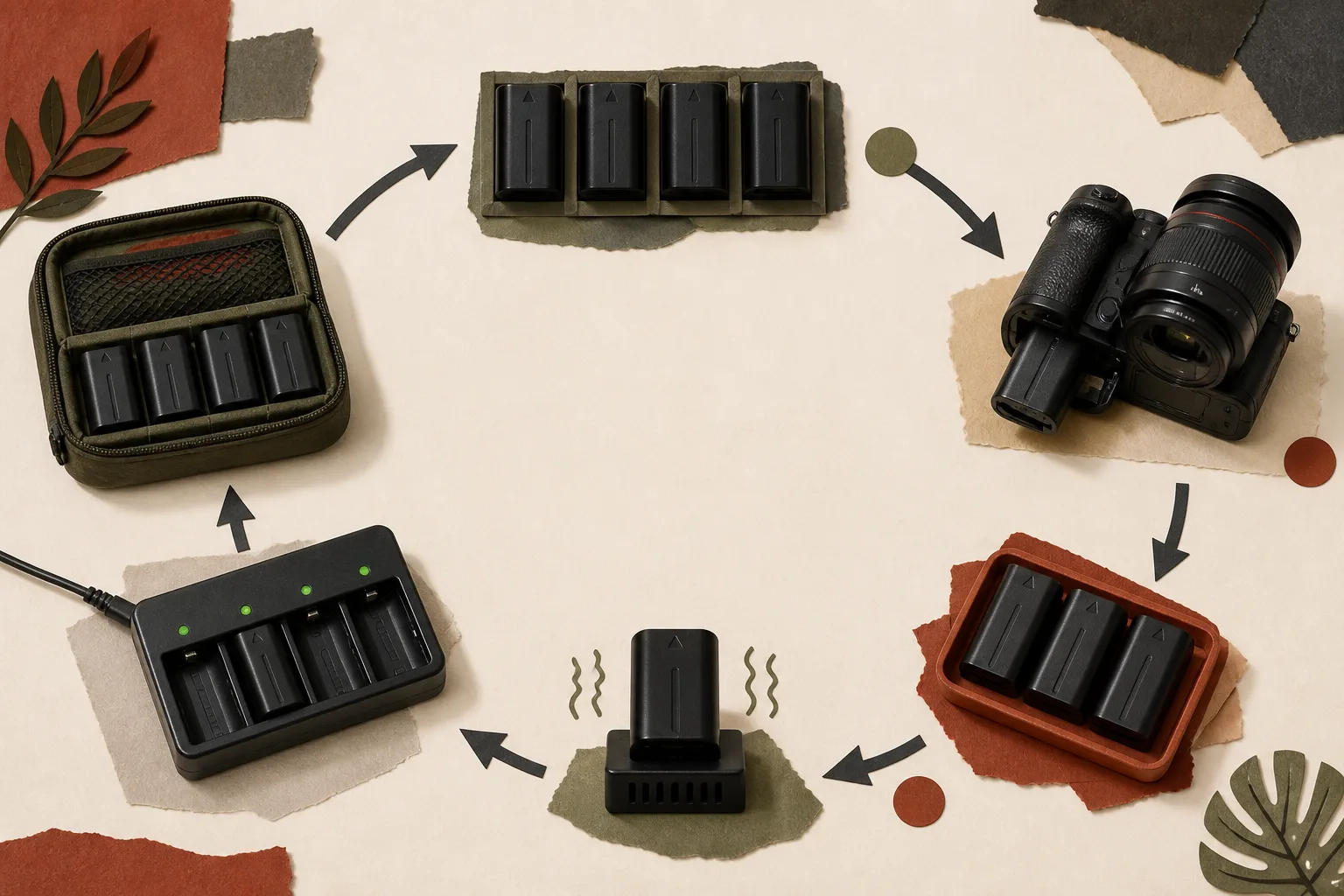
The useful number is not how many batteries are inside the bag. It is how many are ready for the next stage of the production—and whether used units can return safely without becoming confused with them.
Measure consumption in the production mode you will use.
Still photography, long video takes, cold weather, continuous displays, autofocus, stabilization, and connected accessories create different loads. Test the actual resolution, frame rate, focus method, and equipment combination.
Do not rely only on a published shot count. Record practical runtime and the interruption required for a change.
Separate ready and used batteries physically.
Returning both to one pouch makes accidental reuse likely. Move used units to another compartment, reverse their orientation, or use cases that remain distinguishable in dim light.
A memory-based system breaks down during a busy shoot. The physical state should remain clear even when another crew member performs the change.
Cool and inspect before charging.
Allow a hot battery to cool in a safe, ventilated place. Stop using or charging any unit with excessive heat, deformation, swelling, leakage, odor, or damaged contacts.
Charge on a suitable surface with compatible equipment, not buried in fabric or a closed bag. Follow the current safety guidance from the equipment and battery manufacturers.
Backup power is a working return loop—not a pile of cells.
Do not make one charging route a single point of failure.
For a long production, confirm the chargers, adapters, cables, outlets, and time required. If external power is planned, test whether the camera can actually run or charge in the selected recording mode.
Critical work needs either an independent charging route or enough verified ready batteries to survive a failed charger or unavailable outlet.
Use change records to find weak units.
Give each battery a stable identifier and note its start, change time, remaining level, and abnormal behavior. A unit that repeatedly drains early can be removed from production before it causes a stop.
After the shoot, return each unit to the storage condition recommended for it and inspect it again before the next departure.
Keep power moving
- Measure the real production load
- Separate ready and used units physically
- Cool and inspect before charging
- Provide a safe secondary power route
- Track each battery and remove weak units