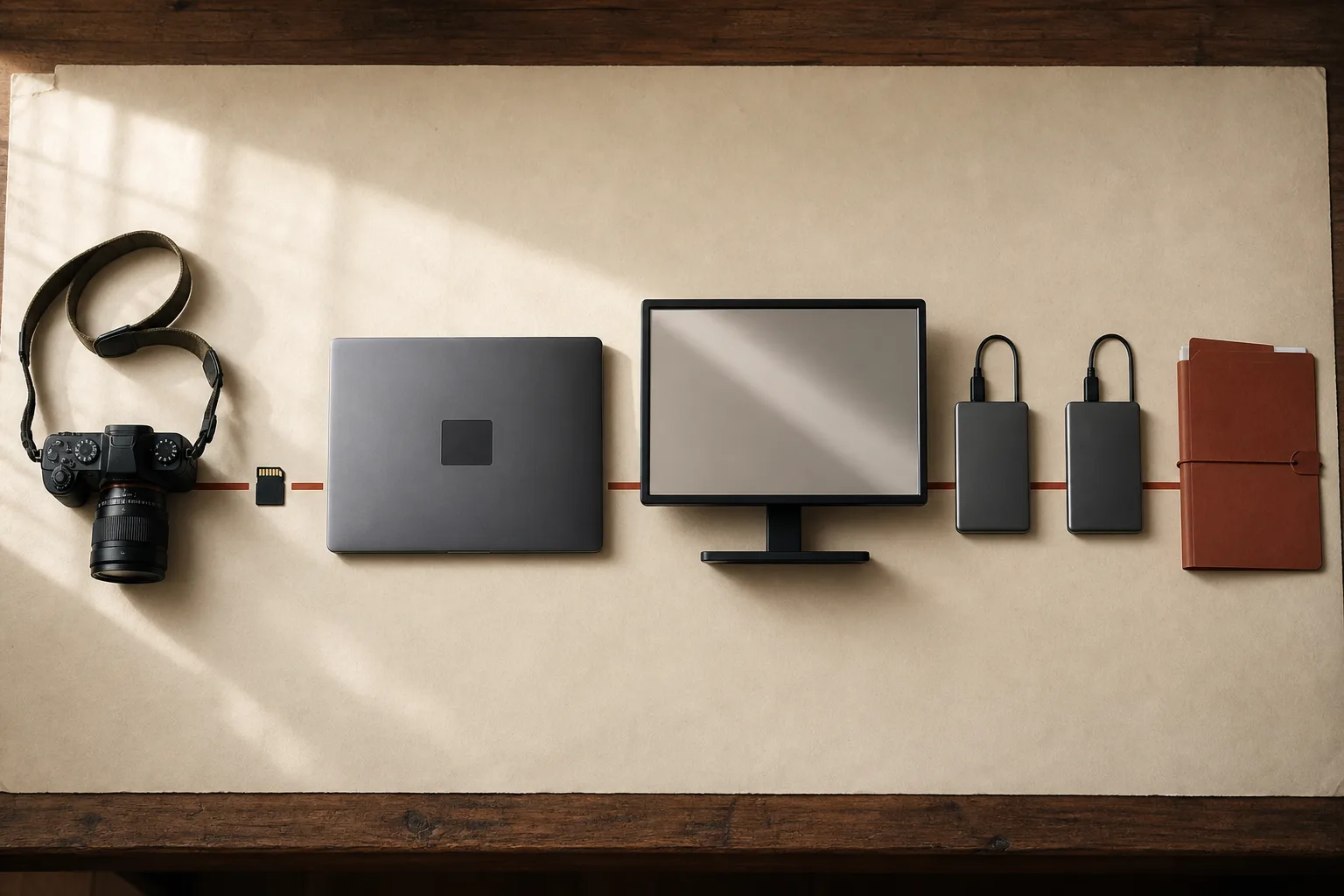
Beginners are often given a shopping list. A working creator needs a workflow. Before comparing brands, follow one file from the moment light reaches the sensor to the moment a clean, backed-up upload reaches a platform.
Start with a capable camera, not a status object.
A recent phone can be useful because it is always with you. A dedicated camera gives you more control over lenses, exposure, file formats, and many difficult lighting conditions. Either can teach the process if the resulting files meet the destination’s current technical requirements.
Used equipment can be rational. Reliability, sensor condition, battery health, and access to suitable lenses matter more than owning the newest body.
Storage begins inside the camera.
Choose cards for the data rate you actually record, not the largest number printed on the package. Video modes may require sustained write performance that a card’s headline speed does not guarantee.
Cards are temporary capture media—not the archive. Make a verified second copy before formatting them.
Buy a lens for the work you can repeat.
A lens affects framing, working distance, low-light capability, and consistency. Kit lenses are not automatically unusable, and expensive glass is not automatically profitable. The better first question is: what subjects can I access often enough to practice and produce?
Stability is part of image quality.
A tripod earns its place when the shutter slows, a composition must stay fixed, or video needs a stable frame. Price alone does not determine usefulness: load capacity, locks, wind, surface, and safe placement all matter.
The computer and connection finish the product.
Capture files are only the beginning. Selection, color work, cleanup, trimming, metadata, backups, and upload require a dependable computer and enough storage. Video also makes upload bandwidth a production constraint, not a convenience.
Buy in workflow order
- Capture reliably
- Store safely
- Edit accurately
- Back up twice
- Upload consistently