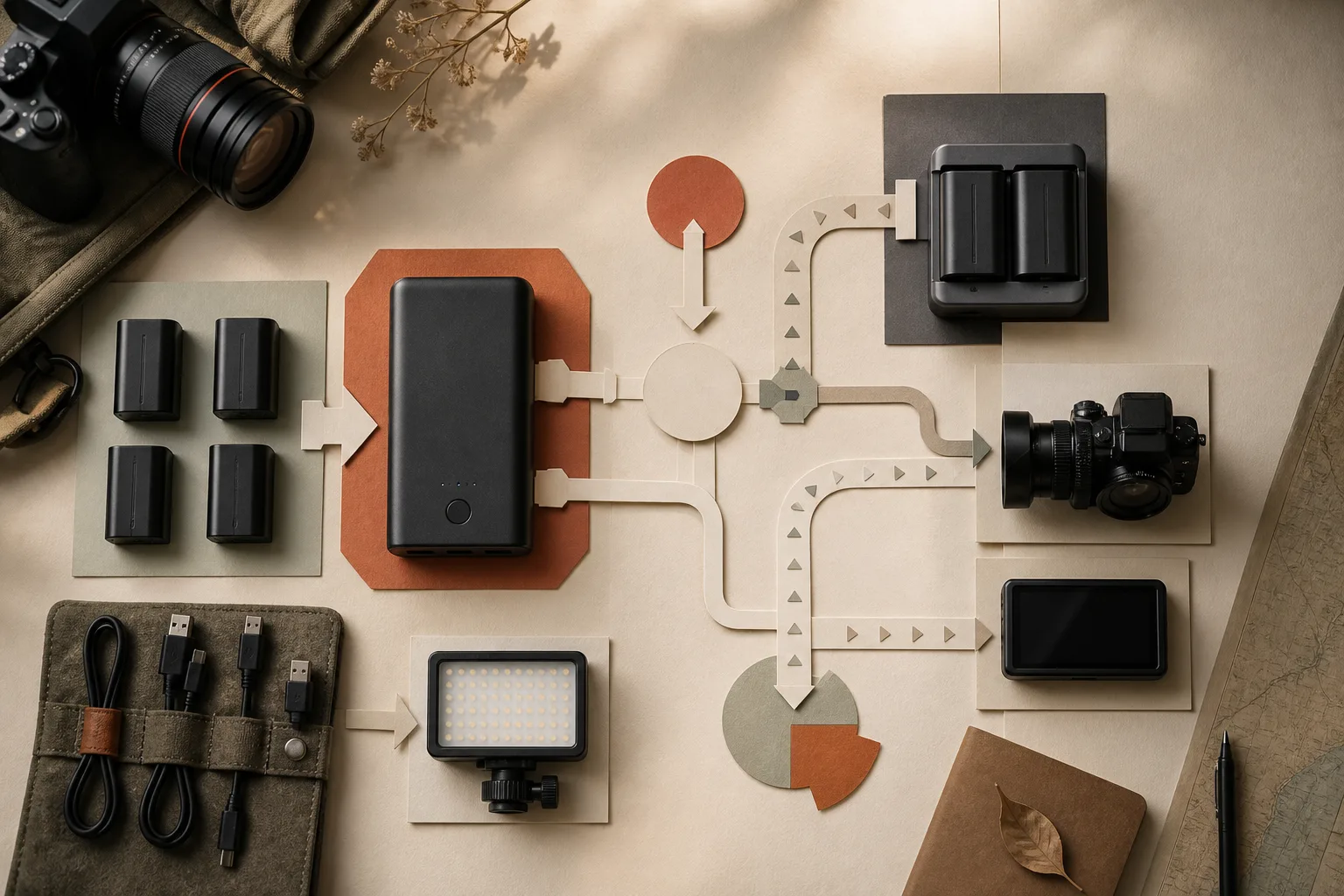
Portable power is an operating system, not a spare object. Capacity, output, ports, cables, and charge time all have to match the field workflow.
Separate charging from continuous operation.
Charging a spare during a break and powering a camera or light while it runs create different requirements. Verify the supported method for every device.
Avoid making every critical function depend on one source.
Do not treat stated capacity as usable capacity.
Voltage conversion, cables, temperature, and device operation create losses. Add margin rather than matching the label exactly to estimated demand.
Measure charges or runtime using the actual recording setup.
Test source, cable, adapter, and device as one system.
A connector can fit while the required power mode is unavailable. Test each complete combination and repeat the test with concurrent loads.
Power margin is proven by completed field time, not by the largest number on the case.
Set charging priority and safe storage.
Charge the devices that would stop production first. Define swap points before the remaining level becomes urgent.
Protect batteries from heat, cold, water, and impact. Stop using any unit with abnormal heat, swelling, or damage.
Power plan
- List devices and power methods
- Add margin to measured consumption
- Test every source-cable-device combination
- Verify performance under concurrent load
- Set charging priority and swap points