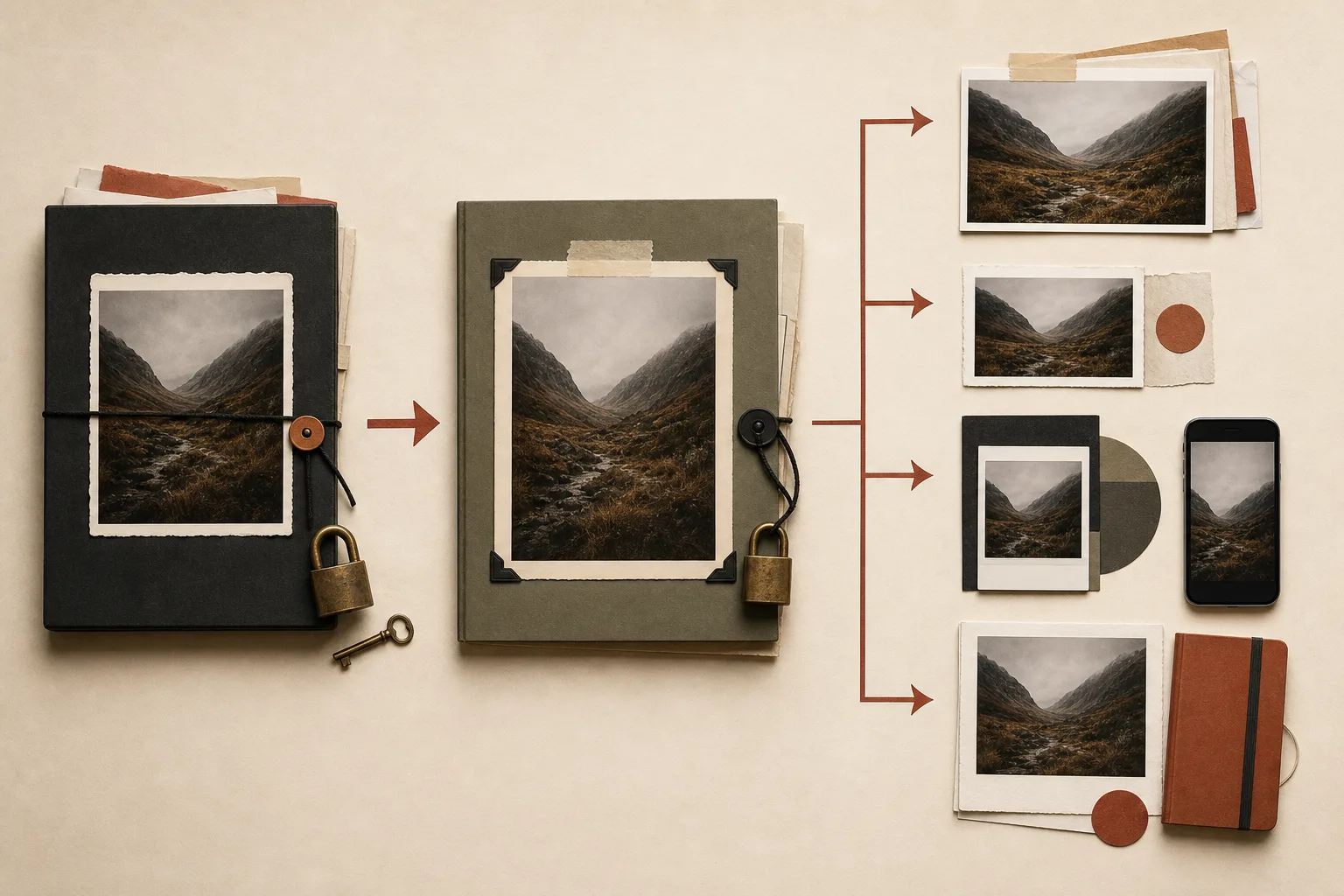
Repeatedly adapting an old JPEG or delivered video stacks compression and conversion while hiding which file is authoritative. Keep the capture source, reproducible edit, and destination export as three different objects.
Protect the state captured by the camera.
Do not normally overwrite raw captures, original JPEGs, source video, or production audio. Store edits and conversions separately.
The source makes a complete rebuild possible when requirements or finishing decisions change.
Keep enough information to reproduce the edit.
The master should retain the color, tone, crop, retouching, audio, timeline, and other decisions required to rebuild the result. Give meaningful revisions dates or version identifiers.
“Final” becomes ambiguous as soon as another correction appears. Name the change, not only the hope that editing has ended.
Export again from the master for each requirement.
Set dimensions, aspect ratio, color space, format, compression, resolution, frame rate, and audio for the destination’s current rules. Do not create the next deliverable by recompressing an earlier one.
Even when two destinations accept the same technical file, retain a record of what was sent where.
Exports are replaceable. The master should keep the route back open.
Inspect the exported file, not only the timeline.
Open the actual deliverable and check dimensions, orientation, color, tone, noise, retouching edges, clip start and end, and audio. A correct master can still produce a wrong export.
Verify the bytes you intend to send rather than trusting the filename.
Connect every derivative with one stable asset ID.
Link the source, master, export, metadata, rights evidence, and submission result. Revisions can change while the underlying asset identity remains stable.
That trace makes correction and resubmission possible without guessing which file produced the current result.
Keep three states distinct
- Source: preserve the captured state
- Master: preserve a reproducible finish
- Export: match one destination’s requirements
- Inspect the actual exported file
- Connect the history with one asset ID