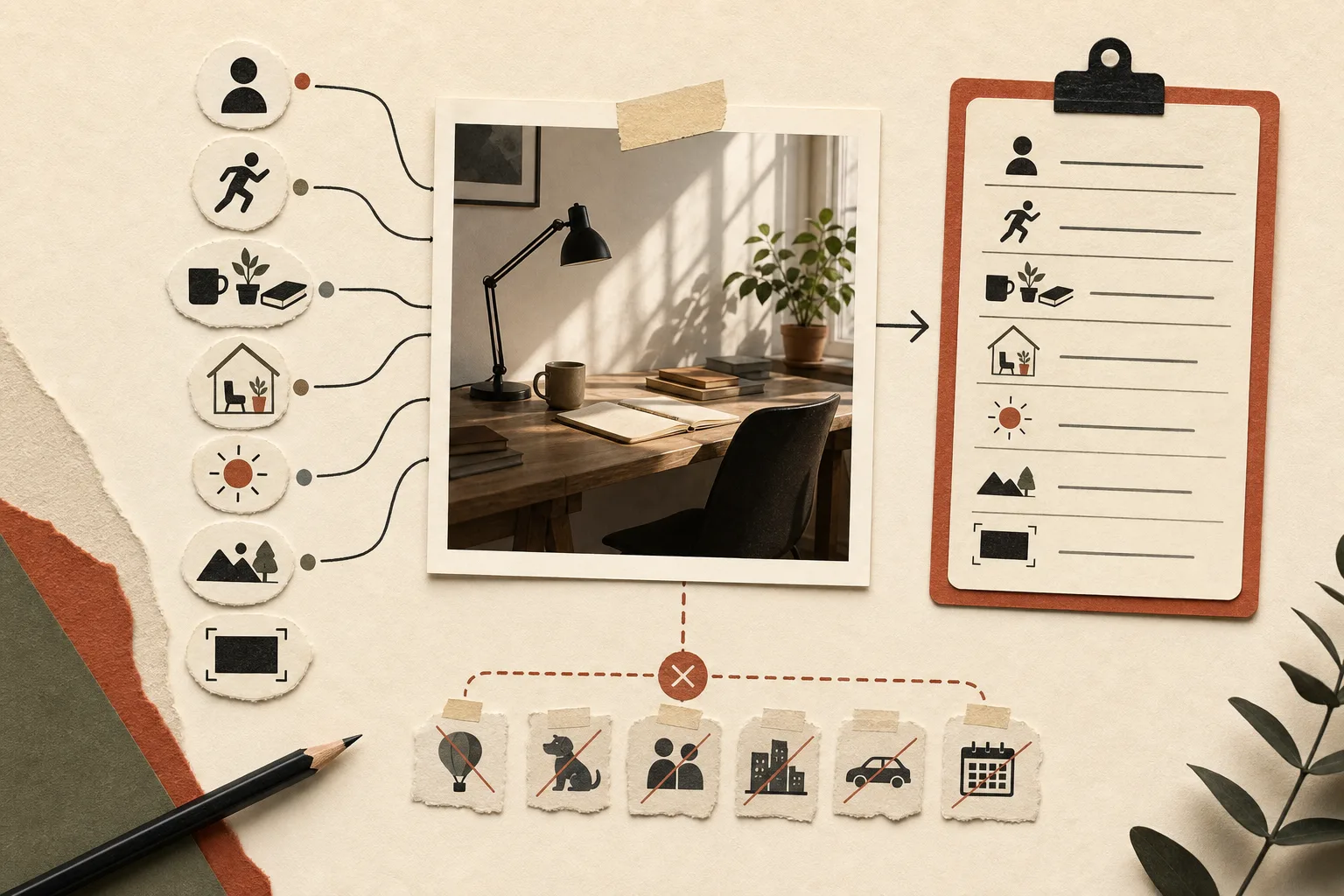
Stock metadata is not promotional copy. It helps a buyer find a scene and understand what it contains. More words do not necessarily improve that job. A smaller set of accurate, important terms is stronger than a larger set that stretches beyond the frame.
Begin with who or what is doing what.
For people, state the count, supportable attributes, action, and setting. Without people, identify the central object, condition, and environment.
Prefer observable language such as “opening a notebook at a desk” over judgments such as “successful” or “stylish.”
Do not invent occupations, emotions, or relationships.
A laptop does not prove someone is an executive. A smile does not prove success. Two people in one frame are not necessarily a couple. Do not turn a visual suggestion into a factual claim.
When production records and releases do not support a detail, step back to a description the frame can carry: a person working, two people talking, or an adult and child.
Put the most important concrete terms first.
Prioritize the central subject, action, setting, important objects, composition, and reliable time or season clues. Do not let a tiny background object outrank the subject.
Repeating synonyms does not add meaning. Choose natural terms a buyer might use while keeping each one relevant to the actual file.
Increase agreement with the photograph—not the number of words.
Review every frame after applying shared metadata.
Batch entry can leave a person, prop, or action attached to photographs where it no longer appears. Apply the reliable shared facts, then open each selected frame and remove what does not belong.
Orientation, copy-space direction, distance, and action stage can also change the practical use, even within one series.
Record why metadata was corrected.
If a destination requests a change, retain the previous wording, stated reason, and corrected version. Repeated problems can then improve the writing and review process.
Destinations may use different fields and rules, so check the current requirements at submission. Preserve the internal source record instead of overwriting it for one platform.
Review each frame for
- The central person or object
- The visible action and condition
- Reliable setting and time clues
- Orientation, framing, and copy space
- Unsupported stories or absent details