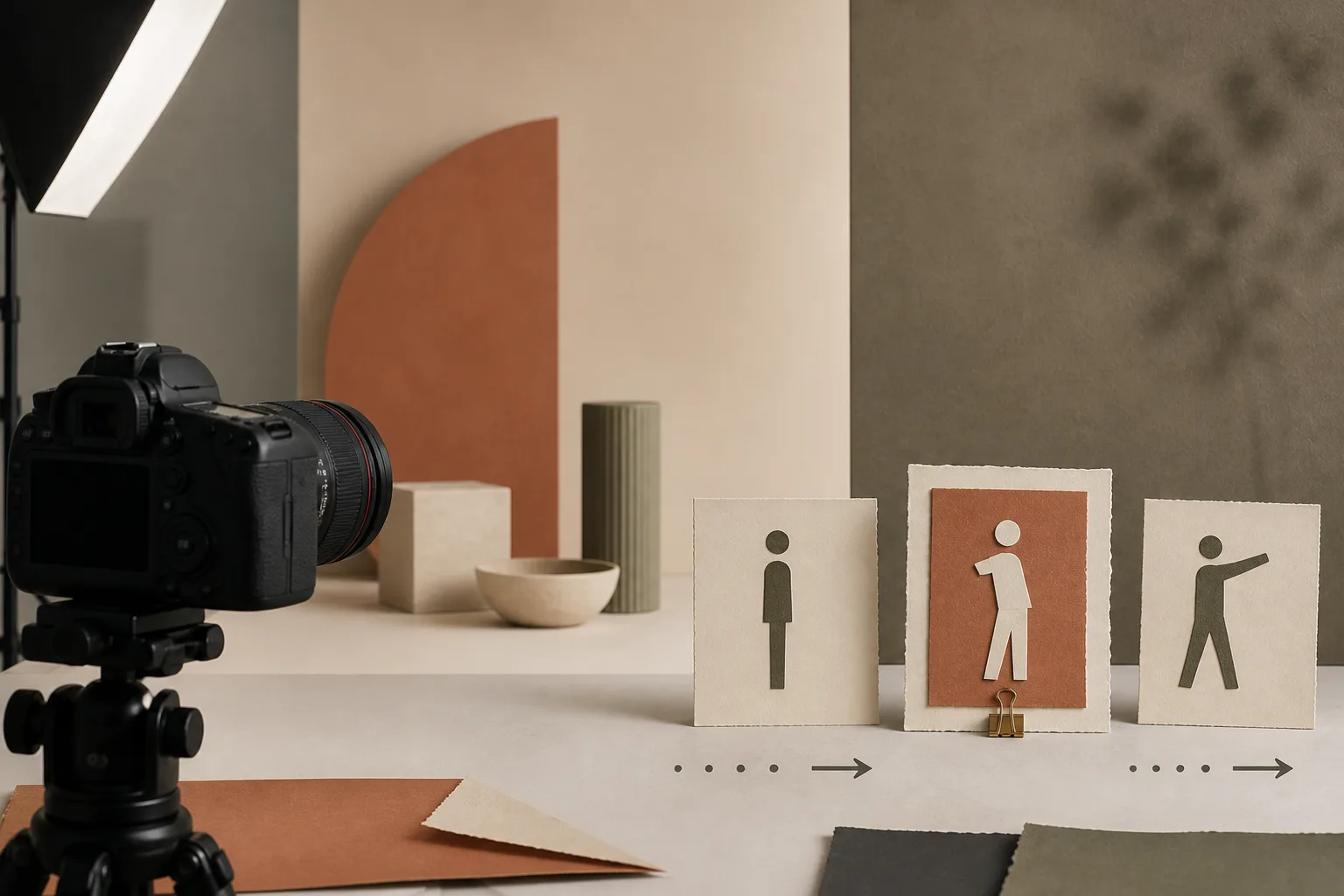
The photographer can see the intended final frame; the participant cannot. Several instructions or an abstract mood delivered at once can turn the expression into a search for the hidden correct answer.
Translate mood into a visible action.
Replace “be natural” with “look toward the window,” “lift the cup,” or “take one step.” Add a brief purpose when it clarifies pace or intensity.
Specify whether left and right refer to the participant or the camera view.
Demonstrate unfamiliar movement.
Show the start and end of a pose or action when words are insufficient. Treat the demonstration as a guide rather than a body shape they must copy exactly.
Before physically adjusting anyone, explain why and obtain clear permission.
Return specific feedback after each attempt.
Name what worked: direction, hand position, or speed. “Wrong” alone gives no usable next step.
Change one instruction while keeping the successful conditions stable.
Direction should describe the next achievable action, not judge the person performing it.
Treat fatigue as a production condition.
Repeated motion, held poses, heat, and cold change expression. Check comfort and offer rest before asking for more energy.
Stop any painful or worrying action and replace it with another solution.
Direction sequence
- Share the intended scene in one sentence
- Give one visible action
- Demonstrate when useful
- Name what worked and change one thing
- Check fatigue and pause