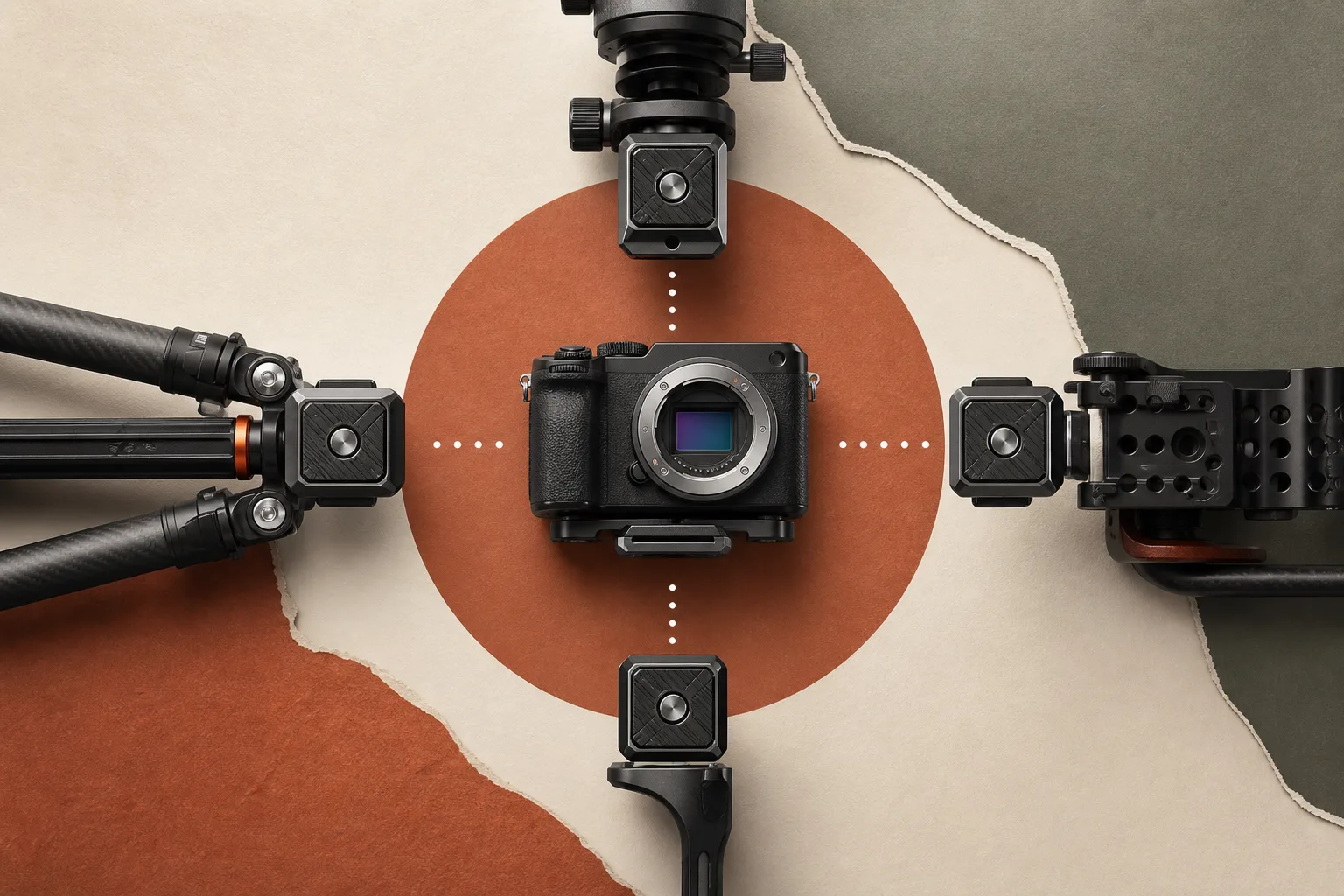
A quick-release plate is more than a faster way to leave a tripod. A consistent connection across frequently used supports reduces the number of adapters, tools, and decisions required in the field.
Map the changes that actually occur.
List the camera, tripod, head, gimbal, slider, and vertical components that are genuinely exchanged. Every item does not need the same interface if the workflows never cross.
Standardize the frequent paths first and avoid tall stacks of adapters.
Verify load and clearance, not only fit.
A plate can attach yet block the battery door, ports, screen, or head controls. Test combined body-and-lens weight, balance, and twisting under vertical orientation.
Use the actual configuration rather than relying on a load rating alone.
Standardize the post-attachment check.
Seat the plate, lock it, apply a light pull test, inspect screw tension, and confirm straps and cables. Use the same sequence every time.
A quick click is not evidence that the camera is secure.
The faster the connection, the more consistent its safety check should be.
Treat small parts as system components.
Label and store plates, screws, tools, spacers, and safety stops by configuration. One missing fastener can disable the entire setup.
Repeat compatibility and tension checks whenever the equipment configuration changes.
Before standardizing
- List the real changeover paths
- Check interface, load, and balance
- Test access to controls, doors, and cables
- Fix one attachment safety sequence
- Include screws and tools in the equipment map