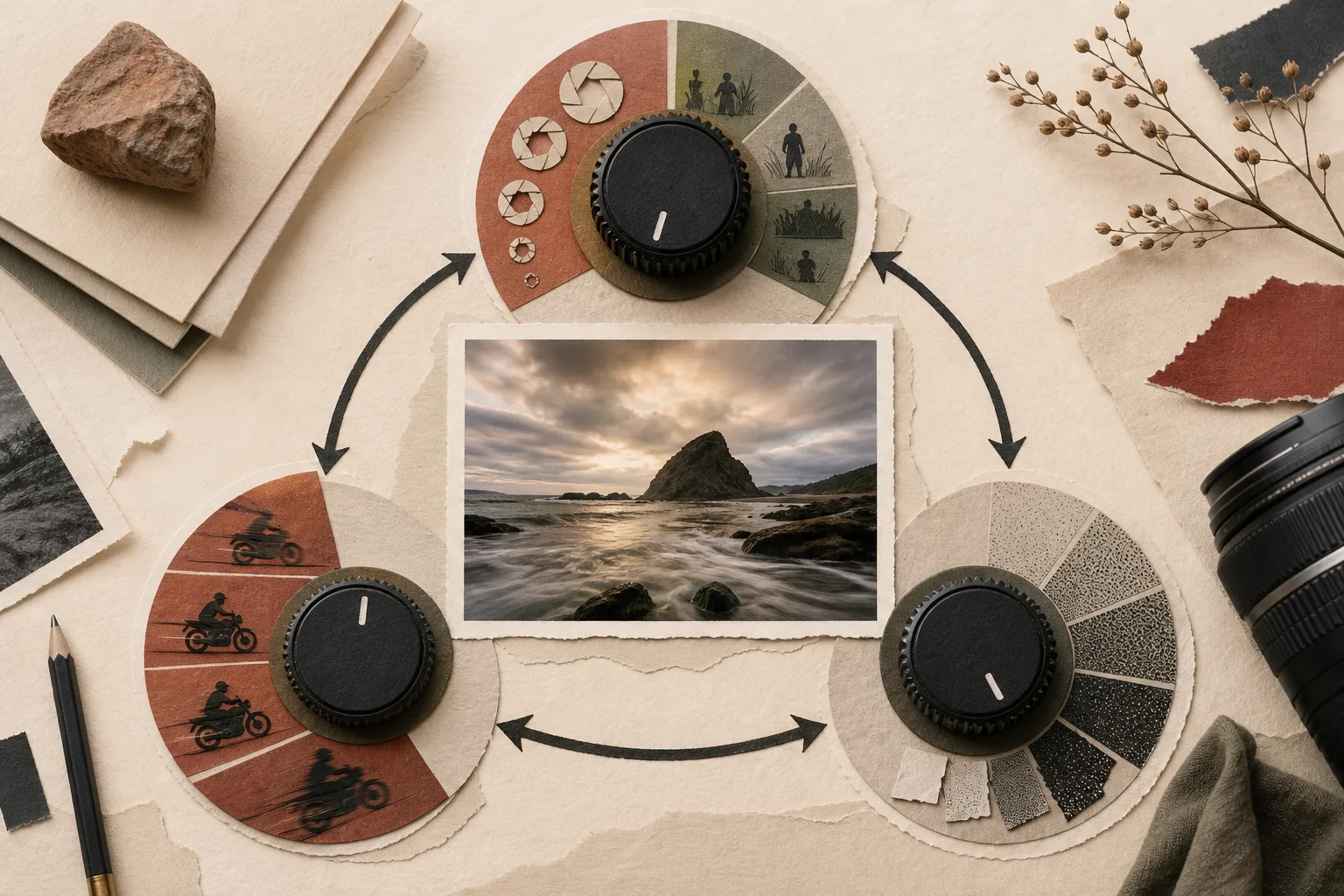
Aperture, shutter speed, and ISO solve different visual problems. Aperture shapes the range that appears acceptably sharp. Shutter speed changes how motion is rendered. ISO helps reach the required brightness while affecting noise and tonal flexibility. There is no useful universal value for any one of them.
Decide what the frame cannot afford to lose.
Do the eyes and product both need to remain sharp? Must a running subject be frozen? Does the dim atmosphere matter more than perfectly clean shadows? The use of the image determines the priority.
Starting with a number puts the photograph second. Name one condition the finished frame must preserve, then choose the setting that protects it.
Choose aperture for the required depth of field.
A wider aperture can separate the subject from the background, but it may also leave part of the subject soft. A smaller aperture can keep more depth usable, while requiring compensation from shutter speed, ISO, or light.
Inspect the important areas at useful magnification. With several people or a product that extends into depth, confirm that the required detail actually falls inside the acceptable range.
Choose shutter speed for the motion you want to keep.
Hands, hair, fabric, water, and vehicles move even when the photographer is steady. Use a faster speed to hold detail or a deliberately slower speed to describe motion.
A shutter speed that prevents camera shake does not necessarily stop the subject. A tripod stabilizes the camera, not the person or object moving through the frame.
Decide what the photograph must keep before you balance its brightness.
Raise ISO only as much as the result requires.
After aperture and shutter speed serve the picture, ISO can supply the remaining sensitivity. Higher values may affect noise, color, and the smoothness of shadows, but refusing to raise ISO can create a blurred or unusably shallow result.
Test the camera before the job and judge the files after the intended finishing process. The practical limit belongs to a camera, exposure, subject, output, and tolerance—not to ISO alone.
Check at the finished size and motion.
Make a short controlled sequence and inspect the decisive detail. For video, watch at normal speed and at the intended delivery speed when they differ.
Record the conditions, settings, intent, and result. The next decision can then begin from evidence instead of memorized numbers.
A practical order
- Name the condition the finished image must preserve
- Choose aperture for the required depth
- Choose shutter speed for the intended motion
- Use ISO to supply the remaining brightness
- Judge quality at the intended output